The compromise between decentralisation and trust. What lies ahead for the virtual asset market
Dec 31, 2025, 6:11pm


Blockchain was conceived as a technology that eliminates the need for trust: the code verifies everything on its own, and the system operates without intermediaries. In theory, it was meant to free users from banks, regulators, and human influence – but in practice, a paradox emerged.
By 2025, the majority of crypto assets are stored on centralized exchanges, and trust has once again become a key element of the ecosystem – only now it’s not about trusting banks, but trusting platforms: those exchanges and crypto services.
This raises a fundamental question: Is it possible to combine scalability and convenience of centralized solutions with the principles of decentralization? Is there a viable compromise?
What guarantees blockchain’s decentralization
The traditional financial system is built on trust – in banks and regulators. We trust that the bank won’t alter the numbers, that the court will recognize a transaction as valid, and that the state will protect our rights. In this model, a human being is always at the center – the one who makes decisions, verifies and ultimately bears responsibility for transactions.
Blockchain was born as a protest against this model. It offers a system where trust is unnecessary – where integrity is ensured not by a person, but by decentralized code.
- Every operation on the network undergoes collective verification and is confirmed by numerous independent participants – nodes (for example, miners in Bitcoin).
- All nodes store identical versions of data and make decisions according to predefined rules. This mechanism, consensus, is the very heart of decentralization.
- Consensus allows thousands of devices across the world to agree on which data is “true”. Any attempt to insert false information is immediately rejected.
- The larger and more diverse the network, the harder it is to cheat the system – since falsifying data would require seizing control of the majority of nodes simultaneously.
In the context of decentralization, consensus is collective verification of truth. Its mechanism may differ – Proof-of-Work, Proof-of-Stake or others – but the goal remains the same: to determine which data is valid, by setting the rules for all nodes in the network.
Another essential property of decentralization is transparency. All transactions are recorded in a public ledger that cannot be altered or forged retroactively and is open for anyone to audit. This creates a paradoxical combination: the system is private at the individual level (conditionally anonymous), yet transparent at the protocol level.
An example of ideal decentralisation
Decentralization gives the user maximum control over their assets.
- Your funds belong to you only to the extent that you control your keys.
- The network is immune to outages or political decisions – it continues to exist as long as at least one node remains. Its rules can change if the majority of nodes agree to it.
- The network operates without a central authority, without an office, without customer support. There are no “borders” or regulators capable of stopping the system with the press of a button.
The perfect example of decentralization that has earned trust through years of flawless operation is Bitcoin itself – a system that has functioned for decades without hacks or third-party interference. Its algorithm is strict, transparent, and independent of any centralized decision-making – be it banks or governments. No one controls Bitcoin.
This is pure decentralization – whose price is lower speed, limited functionality, and a complex user experience. And it is precisely these limitations that have driven the search for compromises – between decentralization (independence) and convenience (adoption).
How the modern cryptocurrency market actually works
However, even though blockchain was built on the idea of eliminating intermediaries, in practice things turned out to be more complex – and most users entered the crypto space through intermediaries.
For the vast majority of people, independence proved to be far less important than convenience. And this led to two key consequences:
- First, today the lion’s share of crypto activity takes place through centralized exchanges and services, where security depends not on code, but on the company behind it. Once again, we look for an intermediary we can trust with our money – only this time, it’s not a bank, but an exchange.
- Second, this shift in priorities has limited the mass adoption of cryptocurrencies in general and decentralized solutions in particular.
They are still primarily used by enthusiasts – those willing to tolerate technical complexity in exchange for full control.
The reason is simple: convenience has defeated the idea.
Self-custody of keys, working with addresses, managing fees and network delays – all of this is too complicated for most people. Centralized platforms made the crypto market easy and fast: one login, a “buy” button, a mobile app, customer support. Everything works “like a bank” – for as long as the platform itself keeps functioning.
At the same time, even within the crypto world, decentralization is far from absolute. Many projects are nominally open but lack sufficient decentralization – effectively being controlled by a few “centers”. Their contracts can be paused, addresses blocked, or rules changed. And assets such as fiat-backed stablecoins depend directly on their issuers. This creates a paradox: a system designed to eliminate trust ends up creating zones of trust within itself.
The path to compromise between decentralisation and trust

Why do people still choose centralized solutions? The short answer: speed, support and interface. They provide a “traditional” sense of security, but more importantly – a familiar and convenient way to manage assets. Users have what they’re used to: login via email, account recovery, “cancel” buttons, and one-click “buy” operations.
This comfort has become the main barrier to mass migration toward decentralization.
Today, the market is gradually searching for a golden mean – a compromise that, for example, allows users to retain control over their assets while removing technical complexity, or that still delegates management to an intermediary but protects user funds through cryptographic encryption and on-chain reserve storage.
These services combine the technological reliability of decentralization with convenience of traditional financial tools. A notable example is Trustee Wallet + Trustee Plus ecosystem:
- Trustee Wallet – a fully non-custodial wallet that protects assets and access keys according to the “rules of the decentralized world”.
Keys and personal data are stored only on the user’s device and never leave it. - Trustee Plus – a custodial service offering a familiar level of convenience, support, and integration with traditional financial infrastructure, while maintaining a cryptographic foundation: encryption of keys and personal data.
To achieve this, it employs protocols such as AES-256, DES, Transport Layer Security (TLS), Rivest-Shamir-Adleman (RSA), and Elliptic-Curve-Cryptography (ECC).
It encrypts both the connection and its signature, using anonymization and access via isolated requests. After registration, users set up a PIN (encryption basis), biometric authentication, and 2FA (via email and Google authentication).
Meanwhile, new technologies are already emerging that aim to bridge the gap between the convenience of centralized systems and the resilience of decentralization.
A new phase: technologies that reconcile decentralisation and convenience

The response to the demand for convenience – while preserving “crypto-currency status” – has been the emergence of technologies that maintain transparency and independence, yet reintroduce the usability and trust familiar from traditional finance.
- Zero-Knowledge Proofs – a technology that allows verification of information without revealing the underlying data. For example, you can prove that you have sufficient funds for a transfer – without showing your balance or transaction history.
- Account Abstraction – previously, wallet management required direct interaction with a private key – losing it meant losing everything. Account Abstraction makes wallets “smarter”: they can function like programmable accounts with customizable access.
- Multisignature – a mechanism that requires the approval of multiple participants to complete a transaction (for example, 2 out of 3 signatures). And social recovery – a method that allows wallet access to be restored through a set of pre-selected trusted contacts, without revealing the private key to them.
What does this enable?
- Verification of truth – without the involvement of banks or regulators, and without revealing the data itself.
- Recovery of access – without compromising privacy.
- Support for alternative authentication methods – via biometrics, password, or social login, without handing over data to a centralized service.
Flexible security settings – spending limits, multisignature rules, time locks. - Multisig and social recovery bring back the human element to blockchain – trust between people, but without intermediaries.
Such solutions form hybrid models: networks remain decentralised in their architecture, while interaction with users becomes intuitive and transparent – almost like in a usual bank.
What lies ahead for the virtual asset market
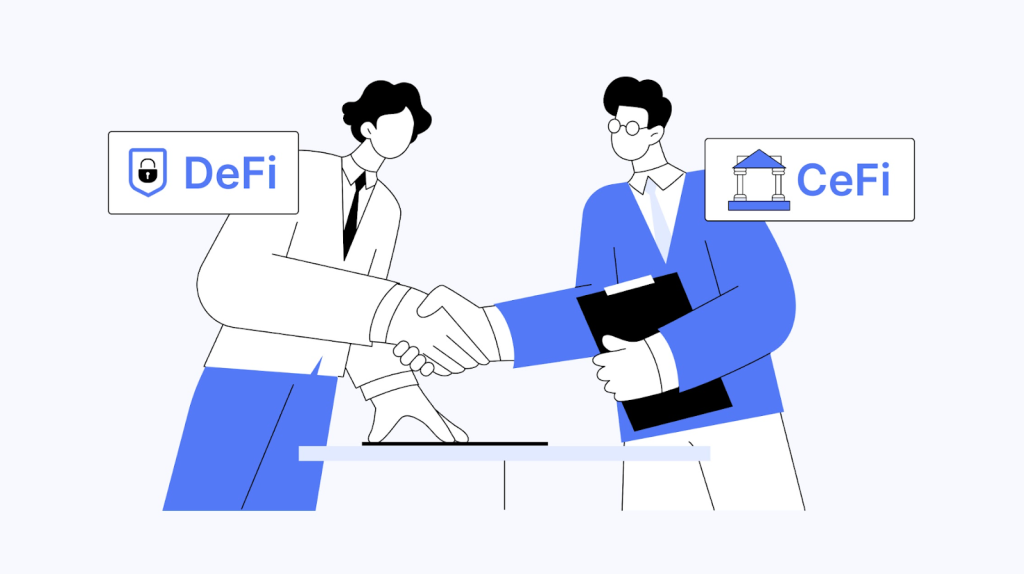
The virtual assets market is entering a phase where the line between DeFi and CeFi is beginning to blur. In the near future, we can expect the emergence of trusted decentralized services capable of combining blockchain-level security with the usability of traditional financial tools.
In this new world, trust returns – but not to people or institutions. It shifts to cryptographic rules that cannot be altered or revoked. This is what will drive the industry toward mass adoption – not through radical freedom, but through “convenient decentralization”: a state where technology remains transparent, yet people no longer need to understand blockchain in order to be 100% owners of their assets.
The future doesn’t lie in choosing between technology and convenience.
But in finding the compromise between them.
About the author:
Maryna Nesterenko is a seasoned customer support leader with over 7 years of experience in the FinTech and crypto-cards sector. As Head of Customer Support at Trustee Plus, she has developed and optimised support operations across multiple regions, helping scale 900k+ customers and manage millions of transactions.