Tokenized Treasuries and the Rise of Real-World Asset Tokens
Dec 09, 2025, 5:41pm


Tokenized U.S. Treasuries crossed $4.2 billion in market cap in March 2025, according to rwa.xyz data cited by CoinDesk. The surge signals that real-world-asset (RWA) tokens—digital claims on off-chain instruments such as government debt, credit, or property—have outgrown pilots and entered everyday finance. When you swap a paper security for an ERC-20 token, settlement shrinks […]
Tokenized U.S. Treasuries crossed $4.2 billion in market cap in March 2025, according to rwa.xyz data cited by CoinDesk. The surge signals that real-world-asset (RWA) tokens—digital claims on off-chain instruments such as government debt, credit, or property—have outgrown pilots and entered everyday finance. When you swap a paper security for an ERC-20 token, settlement shrinks from T+2 days to mere minutes, and trading runs 24/7. In this guide, we’ll unpack four RWA niches where that speed and programmability already translate into concrete gains.
1. Short-term debt and cash management
Tokenized cash equivalents (digital tokens backed 1-to-1 by short-dated U.S. Treasuries or insured bank deposits) now make up the largest RWA segment on public blockchains. As of November 20, 2025, Treasury-backed tokens held a combined market capitalization of about $8.4 billion across 53 instruments, up 3.8 percent over the past week, according to RWA.xyz.
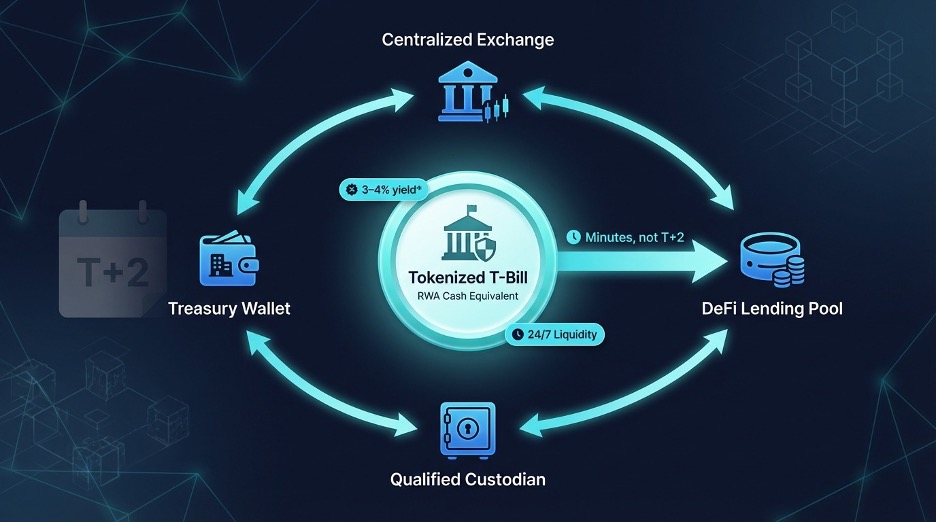
Tokenized T-bills act as on-chain cash equivalents, shuttling liquidity between exchanges, DeFi pools, custodians and corporate treasuries in minutes instead of T+2.
Why investors care:
- Treasuries settle in minutes on-chain instead of T+2 in traditional markets, letting you shuttle liquidity between exchanges, lending pools, and custodians without banking cut-off times.
- The seven-day annualized yield on leading tokens such as BlackRock’s BUIDL or Ondo’s OUSG hovers around 3–4 percent, matching government bill rates while stripping out brokerage frictions, according to CoinDesk.
- Institutional treasurers can sweep idle stablecoin balances into these tokens during the day, keeping assets on regulated rails yet earning interest.
In practice, treasury-token balances move fluidly between centralized exchanges, DeFi lending protocols, and qualified custodians, letting firms manage working capital 24/7 without ever redeeming into cash. That blend of instant settlement, transparent collateral, and familiar risk makes short-term debt the natural first stop for serious RWA adoption.
2. Private credit and alternative yield
Private credit loans to companies, projects, and real-estate ventures outside the banking system now form the second-largest on-chain RWA niche after Treasuries. RWA.xyz counts about $19 billion in active tokenized private-credit loans across ten protocols as of November 2025, up from $7 billion a year earlier.
Tokenization reshapes this once-clubby market:
- Lower entry bar – You can buy $100 slices of Maple or Centrifuge notes instead of writing multimillion-dollar checks.
- Always-on liquidity – ERC-20 loan tokens trade peer-to-peer or on automated market makers, creating an exit path in weeks, not years.
- Programmable collateral – Lenders post the same credit tokens as collateral on DeFi platforms, unlocking capital efficiency, paperwork-free.
Risk still matters. Defaults on pools such as Maple’s unsecured 2023 book remind everyone that credit underwriting counts. Even so, with yields averaging 9–10 percent and managers like Apollo’s tokenized $112 million Diversified Credit Fund already live on-chain, private credit is becoming a practical alternative to high-yield bond funds for investors who understand the trade-offs.
3. Real estate and income-producing assets
Real-estate tokenization is smaller than Treasuries or private credit but growing fast. RWA.xyz lists about $153 million in tokenized property value across 27 projects as of August 8, 2025. Deals range from a single Dubai villa worth $13.6 million on Ctrl Alt to Reental’s $5.1 million U.S. rental portfolio that pays monthly USDC dividends.
Why sponsors are experimenting:
- Fractional ownership. Issuers mint thousands of ERC-20 tokens tied to a deed or SPV, letting investors buy $50–$500 stakes instead of six-figure equity checks.
- Automated cash flow. Rental income lands in a treasury wallet and then streams pro rata to holders via smart-contract splits, which trims manual payout cycles.
Legal due diligence still matters. Property liens, KYC, and regulatory exemptions—usually Reg D or Reg S in the United States—must be airtight before tokens trade on-chain. When those pieces line up, blockchain rails can turn an illiquid building into a 24/7, income-producing asset that plugs directly into DeFi collateral markets.
4. Specialized and niche assets
Tokenization is reaching corners of finance once ruled by insiders and paperwork-heavy marketplaces:
- Digital carbon. More than 20 million tonnes of carbon credits now sit in on-chain treasuries such as KlimaDAO’s Carbonmark, where companies can retire credits with a single Polygon transaction.
- Music royalties. Royal’s first three drops with Nas, Diplo, and others have generated about 413 ETH (≈ US$1.2 million) in secondary trades, and holders receive USDC royalties twice a year when artists get paid, according to CoinDesk.
- Fine art. Freeport won SEC approval in 2023 to fractionalize an Andy Warhol collection, letting investors buy ownership slices for US$250–$860 instead of six-figure gallery prices.
Why should you care about these esoteric assets? Ownership proofs—certificates, master recordings, registry IDs—are already digital, so wrapping them in a token adds transparent cap-table tracking and around-the-clock liquidity. Fractionalization also widens the buyer pool well beyond high-net-worth collectors.
Volumes remain small, at well under one percent of the US$1.9 trillion global art market. Quality concerns, such as issues in Toucan’s early carbon-credit pools, show that due diligence counts just as much on-chain as off. Treat specialized RWAs like venture bets: high upside, high risk, and best sized modestly inside a diversified portfolio.
What all successful use cases have in common
A 2024 BIS report for the G20 states that token arrangements scale only when “sound governance, clear legal claims, and reliable service-layer infrastructure” move in lockstep. BlackRock’s BUIDL fund shows the formula in action: the token sits inside a regulated 1940-Act trust, assets stay at Coinbase Custody, and the fund has grown to about US$1.7 billion since its 2023 launch, according to CoinDesk.
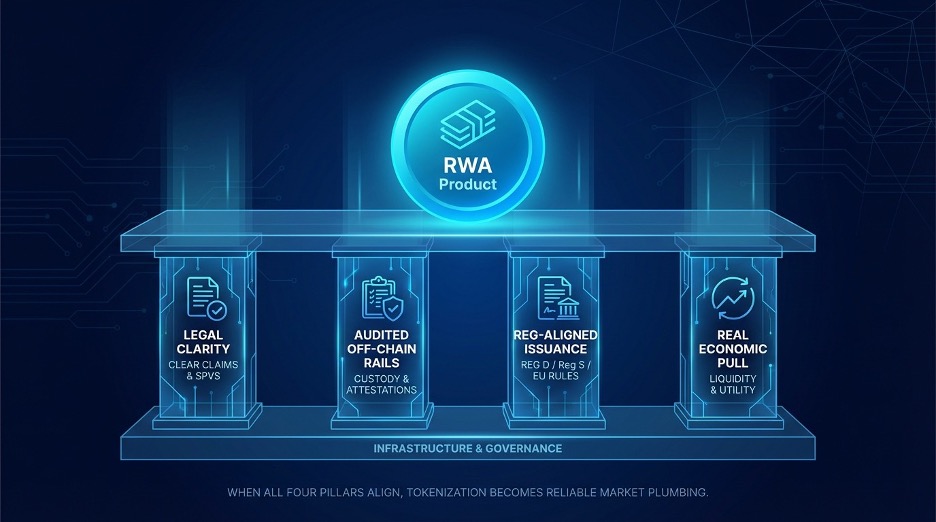
Every durable RWA product rests on four pillars: legal clarity, audited off-chain rails, regulatory alignment and real economic demand.
Across the top RWA protocols tracked by RWA.xyz, every high-volume product checks these four boxes:
- Legal clarity. Token holders know exactly which LLC, trust, or SPV owns the off-chain asset, and offering documents are public.
- Audited off-chain rails. Qualified custodians, servicers, and trustees file third-party attestations at least quarterly.
- Reg-aligned issuance. Most issuers use exemptions such as Reg D, Reg S, or the EU Prospectus Regulation instead of opaque structures.
- Real economic pull. Market cap grows because users need 24/7 liquidity, automated payouts, or collateral mobility, not just because “crypto wants new toys.” Purpose-built blockchains such as Polymesh were engineered specifically for real world assets, baking identity checks, rule-based transfers, and deterministic settlement into the base protocol: an architecture that satisfies these four requirements without the patchwork risk of add-on compliance contracts.
When you see all four conditions lined up, tokenization stops being a buzzword and starts acting like reliable market plumbing.
How institutions can approach RWAs
Interest has moved from board-room talk to funded pilots. A 2025 State Street report found 54 percent of asset-management executives expect their digital-asset exposure to double by 2028, starting with private credit and short-term debt, according to CoinDesk. Live projects show that an institution’s learning curve usually follows three milestones:
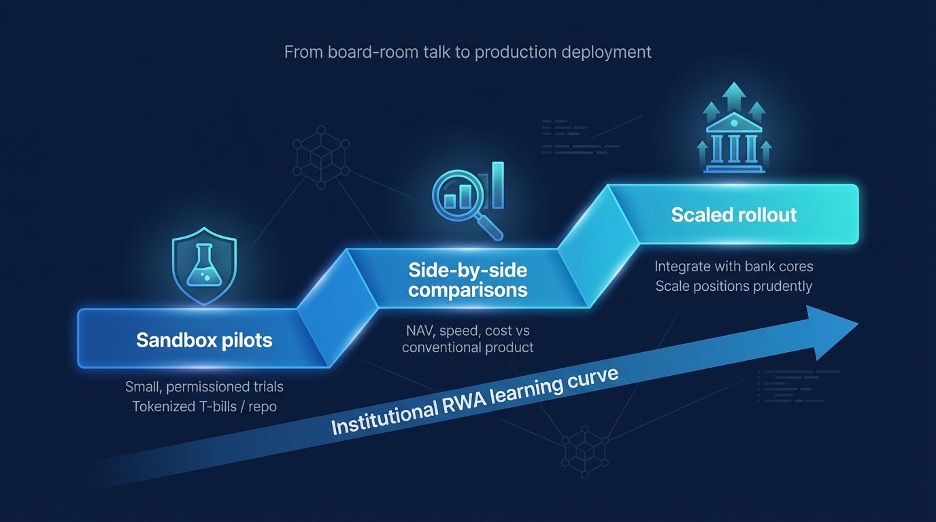
Institutions typically move from sandbox pilots to side-by-side comparisons before scaling real-world asset tokenization into production.
- Sandbox pilots. Run a small, permissioned trial, often a tokenized Treasury-bill fund or repo facility, so your operations, risk, and compliance teams can test the tech without moving client assets.
- Side-by-side comparisons. Evaluate daily NAV, settlement speed, and cost against the conventional product. DBS processed US$1 billion in tokenized structured-note trades in H1 2025 and saw volumes climb nearly 60 percent quarter over quarter, according to CoinDesk.
- Scaled rollout. Scale positions only when tokenization clearly improves liquidity, collateral mobility, or regulatory capital treatment. IBM’s 2025 digital-asset platform plugs those production workloads into bank cores, according to CoinDesk.
You do not have to go all in on crypto on day one, but solid pilot data makes it easier for boards and regulators to green-light the next step when the economics pencil out.
A sensible approach for individuals
Retail investors follow the same rules on-chain as off. In a July 9, 2025 SEC statement, Commissioner Hester Peirce reminded markets that “tokenized securities are still securities” and must sit inside existing disclosure and custody laws.
- Read the docs, then the docs behind the docs. Skim the term sheet, and then read the private-placement memorandum or Form D filing to confirm what rights the token grants—interest, voting, and redemption.
- Check the yield against reality. Treasury-backed tokens paid about 3.9 percent annualized in November 2025; anything offering double-digit returns deserves close scrutiny for credit risk or leverage, according to CoinDesk.
- Size positions modestly. FINRA’s suitability rule still applies, and many advisors cap emerging-asset exposure at five percent of a diversified portfolio.
- Diversify issuers and structures. Mix regulated money-market tokens with small slices of private-credit pools to spread risk.
When you judge tokenized RWAs through the familiar trio of return, risk, and liquidity, they look like a technical upgrade rather than a shortcut to oversized gains.
Conclusion
Tokenization is no longer an experiment—it is a practical tool improving settlement speed, liquidity, and access across multiple asset classes. By focusing on legally sound structures and real economic utility, both institutions and individuals can harness real-world assets on-chain without losing sight of traditional risk disciplines.